First reflections are the earliest strong copies of loudspeaker sound arriving from nearby boundaries. Their level, delay, spectrum and direction determine whether they blur localisation, change timbre or contribute useful spaciousness.
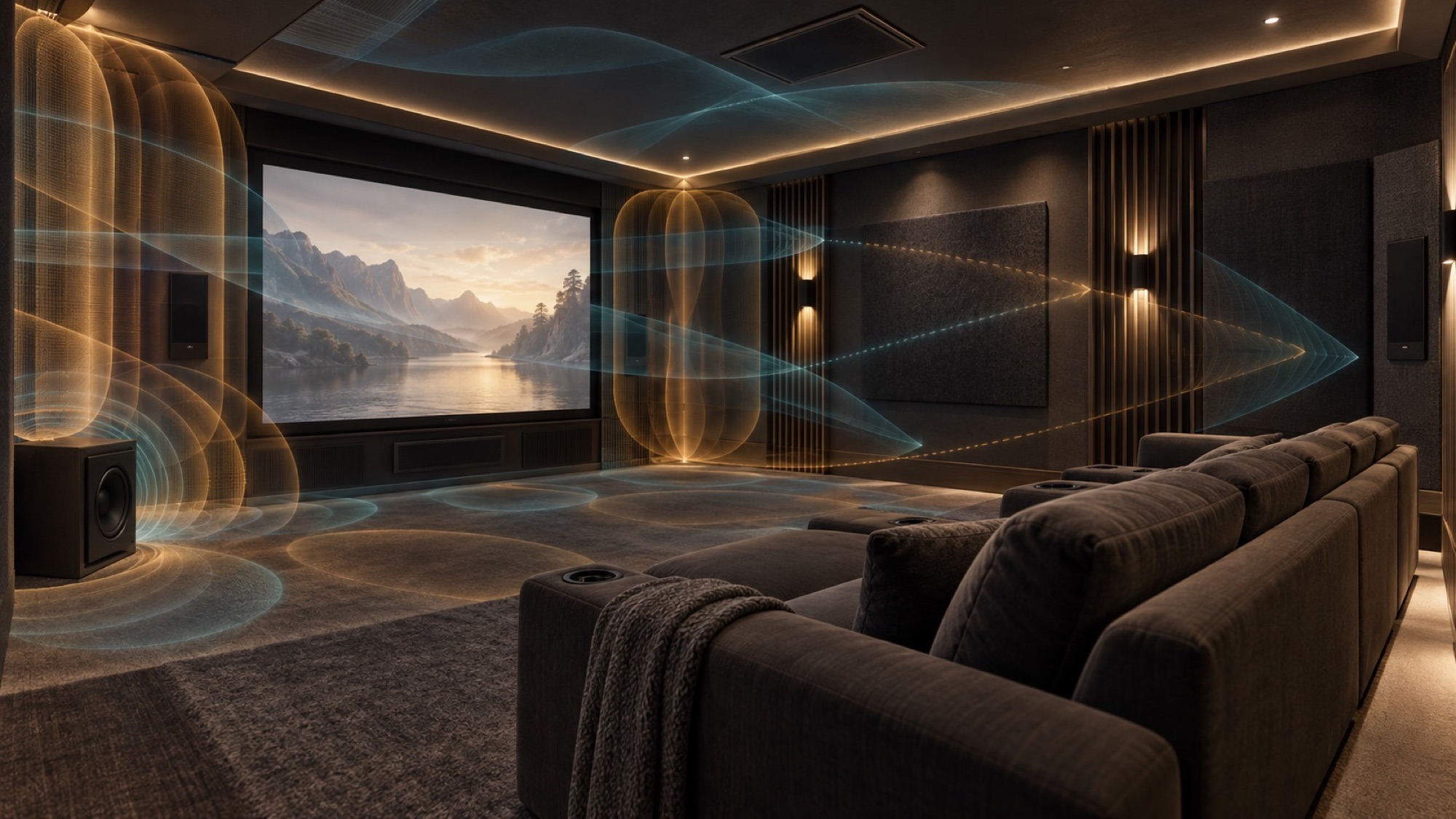
The first arrivals matter
Reflections reaching the listener shortly after the direct sound can change localisation, timbre and perceived image width.
Speaker directivity changes the problem
A narrow-directivity loudspeaker sends less energy toward some boundaries than a wide-dispersion design. Treatment decisions should therefore be related to the actual speaker radiation pattern.
Absorption is one option
Absorbing a reflection can improve precision, but it also removes energy from the room. In some positions, redirection, diffusion or leaving a surface reflective may produce a better spatial result.
Measure the complete room
The best reflection strategy considers left/right symmetry, side surrounds, Atmos channels, seating distance and the decay balance across frequency.
Find the reflection path before selecting treatment
Side walls are only part of the problem. Floors, ceilings, screen walls, rear walls, joinery and even large seat backs can generate early energy. Geometric ray tracing is useful at mid and high frequencies, while measurements help confirm arrival time and level in the completed room.
The correct response depends on loudspeaker directivity and seat coverage. A narrow-directivity system may excite a side wall very differently from a wide-dispersion loudspeaker. Treating a point copied from a generic mirror diagram without considering the actual loudspeaker can waste valuable surface area.
Absorb, redirect or retain?
Absorption is often chosen where a strong early arrival harms dialogue clarity or imaging. Angled or shaped surfaces can redirect energy away from seats, while diffusion can be useful when listeners are far enough away for the scattered field to integrate. In a small room, a deep diffuser placed too close may create audible spectral or spatial artefacts.
Coordinate reflection treatment with surround and height channels. A surface that helps the front soundstage must not block, shadow or unevenly absorb the loudspeakers responsible for envelopment.
Use acoustic theory to ask better questions about the actual room. Final treatment quantity, location and construction should be based on the project geometry and measured or modelled behaviour.