IsoMax
A resilient isolation clip for decoupling common furring channel and gypsum-board linings from wall or ceiling structure.
One of the most relevant reference manufacturers for the construction side of cinema acoustics: resilient isolation, acoustic doors and integrated fabric-covered treatment.

IsoMax clips are designed to resiliently decouple wall and ceiling finishes from structure, while Kinetics’ home-theatre literature also covers isolated walls, ceilings, floors, acoustic doors, utility-box treatment and damping.
StretchTRAK addresses the internal-room side: absorbers and diffusers can be concealed behind a continuous fabric finish, which is highly relevant to architectural private cinema.
Construction systems are specified project by project; smaller retail acoustic products can still be routed through Home Cinema Store where appropriate.
Kinetics Noise Control was established in 1958 as a team of industrial consultants focused on sound and vibration. The company subsequently developed a broad manufactured portfolio covering airborne-noise control, structure-borne vibration isolation, room acoustics and the restraint of non-structural building services.
That history matters in private cinema because isolation is a building-system problem. The wall clip, ceiling suspension, floating floor, door, duct connection and equipment support all influence the result. Kinetics is therefore a useful reference when the brief goes beyond decorative room treatment.
In 2020 Kinetics became part of Catalyst Acoustics Group. Its published product and engineering material continues to span architectural, industrial, mechanical-services and vibration-control applications.
A resilient clip is only one component of a coordinated isolation envelope.
IsoMax resilient clips decouple gypsum-board finishes from framing to reduce structure-borne transmission when used in an appropriate tested assembly.
Isolation mounts and floating-floor approaches help separate impact, equipment and low-frequency vibration from the supporting structure.
Acoustic doors, utility-box details and mechanical-service isolation address weak points that can bypass otherwise substantial walls.
StretchTRAK provides a fabric-finished route for concealing absorptive and diffusive treatment inside the completed room.
Kinetics connects architectural acoustics to mechanical vibration and construction isolation. That systems view is valuable when cinema bass must be contained without creating rigid flanking paths.
This page does not imply South African agency or routine stock. Product selection, tested build-up, fire requirements, import route and installer capability must be confirmed for each project.
Kinetics Noise Control grew from vibration-isolation engineering into a wide architectural noise-control portfolio. For private cinema, its relevance is the coordinated treatment of walls, ceilings, floors, doors, penetrations and mechanical services.
Isolation succeeds as an assembly. Clips, channels, mass layers, absorptive cavity infill and sealant only deliver their intended result when junctions and penetrations preserve the decoupled path.
Selected product families are highlighted for their relevance to private cinema—not as a shopping list.
A resilient isolation clip for decoupling common furring channel and gypsum-board linings from wall or ceiling structure.
A rollout isolation system used beneath framed floating floors to create a resilient airspace and reduce structural vibration transfer.
Damping compound and mass-loaded vinyl options used where the engineered wall or ceiling assembly calls for added damping or limp mass.
Ceiling hangers, outlet backers, door systems and duct silencers address flanking paths that a wall-only solution misses.
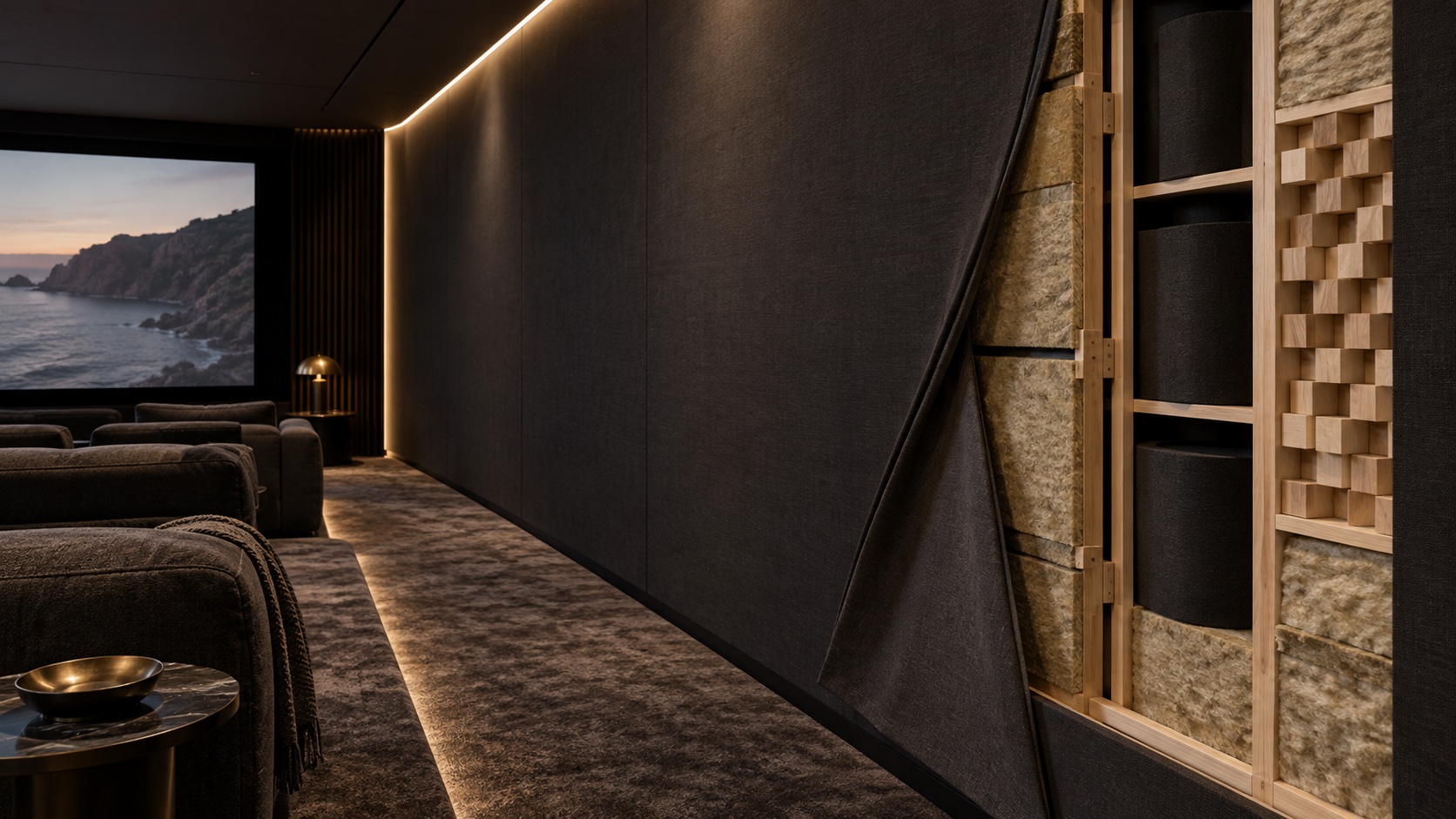 ILLUSTRATIVE DESIGN STUDY · NOT MANUFACTURER PHOTOGRAPHY
We use the Kinetics catalogue as a reminder that a cinema shell is a network of transmission paths. The correct solution is a documented wall, floor, ceiling, door and HVAC strategy with site quality control.
The governing principle: measurement, modelling and room requirements choose the treatment. The logo never does.
See our acoustic-design approach →International technical reference. Product substitutions must be checked against assembly performance; locally available equivalents should never be assumed to be identical.
Open the relevant product reference →